

What Top Sustainability Standards Get Wrong About Community
A review of LEED, SITES, SEED and LBC through the lens of social cohesion. (Reading Time: just under 6 minutes)

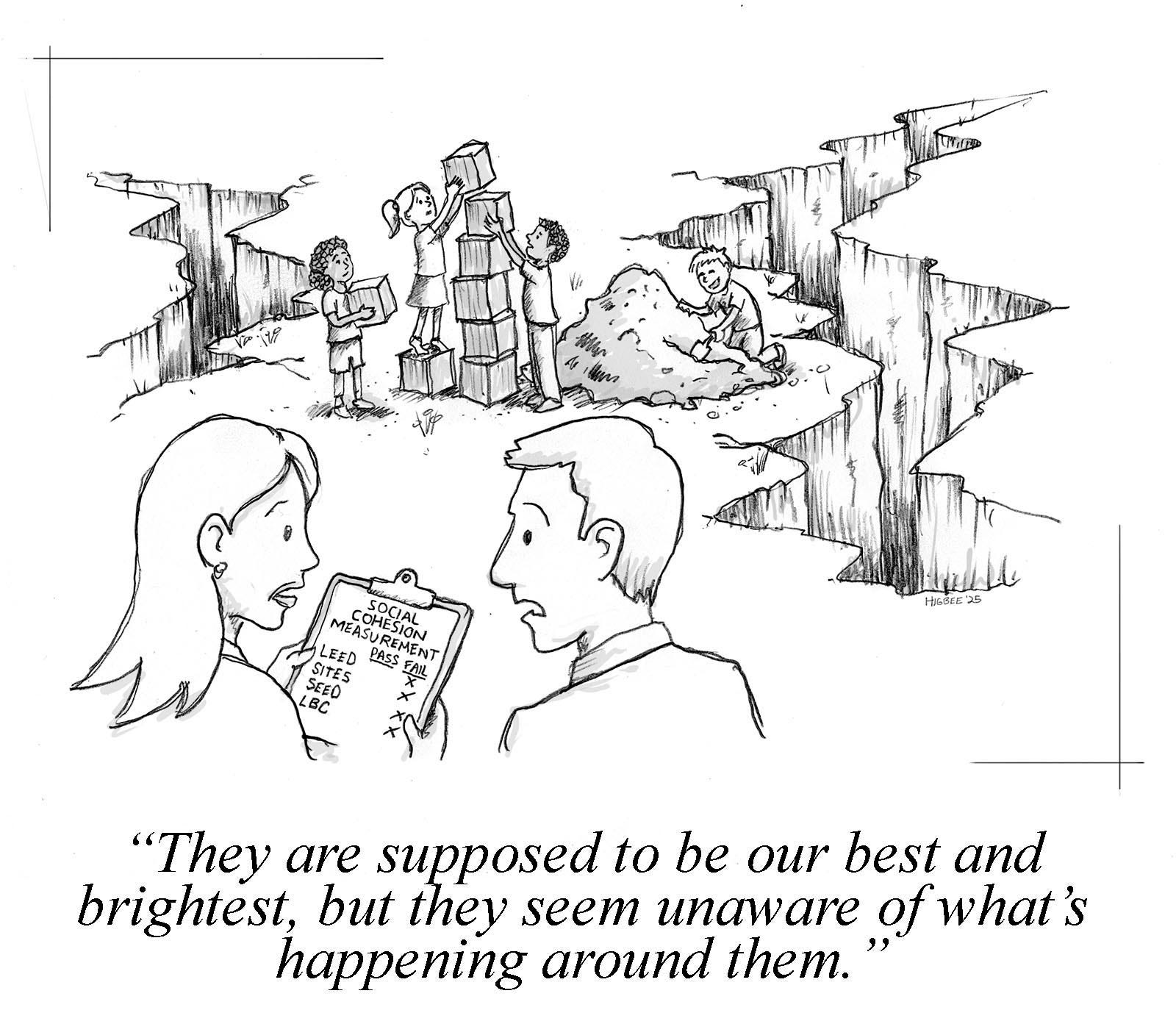
In my last post, I described how measurement standards like LEED (Leadership in Energy and Environmental Design) accelerated the widespread adoption of sustainable design practices. These standards took a previously fuzzy invisible concept — sustainability — and gamefied it onto the balance sheets of those wielding power and capital.
Nice move, sustainable design.
We now face a similar crisis to the environmental movement, but this time with social fragmentation. Can we take an equally fuzzy concept left off the balance sheets — let’s call it “social-cohesion” — and again incentivize the folks with power and capital to take notice?
Can we take an equally fuzzy concept left off the balance sheets — let’s call it “social-cohesion” — and again incentivize the folks with power and capital to take notice?
We’re entering an era of social renewal, and there’s many people doing remarkable things to cultivate strong cohesive local communities.
But I’m convinced that place-based community engagement stands a head above the rest. There’s just something uniquely powerful about meeting, collaborating, visioning, and shaping a shared future together. It’s like rocket-fuel for social cohesion. (Check out my recent (re)post about Silverton for an example.)
And, lo-and-behold, community engagement is already embedded in how local governments and built-environment professions operate. Yet, amongst the hundreds of engagement processes that are underway at any given moment, few unleash their socially cohesive potential. Instead, they settle for a lesser, yet still worthy, goal of soliciting input to inform design, planning, or policy decisions.
So, here’s my question: can measurement standards once again spur a revolution in how we shape the world? But this time focused on process and community, rather than on products and sustainability?
But wait, don’t some of the current sustainable measurement standards already address engagement?
After digging through them, the answer is no. Although sometimes they try. And the reasons are indicative of the current blockages that keep us from rising to this challenge. Let’s take a look.
LEED (LEADERSHIP IN ENERGY AND ENVIRONMENTAL DESIGN)
LEED is the big name on the block for measuring and certifying “sustainability.” Yet none of its 80 credits has anything to do with building community or community engagement.
Sure, it’s a sustainability standard, so maybe it’s unrealistic to expect it to address the social components of the built environment. But that hasn’t stopped LEED from dipping its toe in the engagement waters with a “pilot credit” called “Social Equity within the Community.” What’s that about?
Unfortunately, this credit is not concerned with supporting socially cohesive communities. Instead, it centers on needs-based approaches and community-based organizations — problematic methods I dissected in “Beyond Equitable and Authentic Engagement,” and “How (and How Not to) Work with CBOs.”
Equity work is important, but equitable outcomes are not the same as community-building outcomes. Focusing solely on equitable engagement ignores the rest of the complex set of challenges facing our society, like loneliness and polarization.
We desperately need place-based efforts that cultivate cross-cutting relationships and a pluralistic society. Community engagement, properly conceived and executed, does this in spades. But engagement that sorts people according to their ascriptive identities and their deficiencies does not.
We desperately need place-based efforts that cultivate cross-cutting relationships and a pluralistic society. Community engagement, properly conceived and executed, can do this
LEED allows this pilot credit to be documented by another standard, the Social Economic Environmental Design Evaluator. So let’s look there next.
SOCIAL, ECONOMIC, & ENVIRONMENTAL DESIGN (SEED) EVALUATOR
The SEED Network sits at the forefront of “Public Interest Design,” which is how architects refer to their socially oriented architecture practices. The folks behind SEED have recognized the value of measurement and developed a tool called the “SEED Evaluator.” Through a series of questions, the Evaluator asks applicants about their project’s public benefit goals and how they worked with communities to achieve those goals. A committee reviews applications, and if deemed successful, a project can become “SEED Certified.”
Isn’t SEED, then, the measurement tool we are looking for?
Unfortunately, no. The key thrust of the SEED Evaluator is determining whether a design process reflects a community’s concerns, not on a design process’s socially cohesive impact.
Yes, it’s important that we listen to communities and incorporate their hopes and dreams. But a project can reflect a community’s desires without generating social connections or cohesion. Community engagement is not community building.
The SEED Evaluator is also very explicit in that is evaluating the results of the project, not the process. This is a critical distinction that I addressed recently in “Process ≠ Product: Why Community Engagement Needs Its Own Scorecard.”
Okay, next?
THE SUSTAINABLE SITES INITIATIVE (SITES)
SITES is landscape architecture’s answer to the building-centric focus of LEED. SITES and LEED are increasingly integrated, with SITES credits now counting toward LEED credits.
SITES has a credit explicitly for community engagement: Credit 2.4 “Engage Users and Stakeholders.” At last, we found one! Way to go, landscape architects.
However, the requirements for this credit are minimal and vague. For example, “present the design to the public,” or “invite site users and stakeholders to the design development presentation.” That’s outreach, not engagement, and certainly not social cohesion.
In addition, this credit includes a catch-all list of recommendations, specifically mentioning “web-based or town hall-style presentations.” These types of engagement strategies, as I’ve previously written, are the least effective techniques for social cohesion. And town halls?! Ugh - the worst!
Without robust requirements, practitioners can simply check this SITES 2.4 credit box and limbo under a non-existent bar.
LIVING BUILDING CHALLENGE (LBC)
The Living Building Challenge (LBC) by the Living Futures Institute (LFI), is arguably the most rigorous sustainable standard today. LFI leans heavily on the language of regenerative design. So one would think that their measurement standards would address the socially regenerative potential of the design and planning process. In fact, I co-opted the LFI’s prominently featured “Trajectory of Sustainable Design” to convey similar ideas about community engagement.
Yet there’s nothing about community engagement or regenerative communities in any of its standards.
However, perhaps their “Living Community Challenge” (LCC) certification is worth examining, since it potentially applies to working with communities?
A closer look reveals that the LCC is just a way to apply its building-focused approach to a larger scale. And like the other standards, it maintains a myopic view on design products, not the engagement process. Its “Resilient Community Connections” category is actually a measure of disaster preparedness. It’s “Healthy Neighborhood Design” and “Universal Access to Community Services” categories focus on health and accessibility outcomes, not on social connections.
To boot, the “engagement” section of the LCC Handbook focuses on how to convince communities to support the Living Community Challenge concept. That’s recruitment, not engagement.
The LCC is no longer accepting new registrations. A response to an email inquiry from LFI noted that the organization “lacks the resources and capacity to support the program” and it’s not in the three-year plan to bring it back. Supporting social cohesion is clearly not a priority.
—
Okay, let’s pause here. Existing built environment measurement standards have so far failed to provide a way to measure the social cohesive outcomes of both engagement processes and design outcomes.
So next time we’ll cast our gaze to other disciplines, like social psychology and public health. They say all great cultural and technical leaps come from inter-disciplinary cross-pollination (a.k.a. the Medici Effect), so let’s peer over the fence at what they have going on.
~Eric
What Else I’m Reading
THE BREAKDOWN: The gathering strategy behind Zohran Mamdani’s historic win by Priya Park in Group Life Substack
I really enjoyed Priya Parker’s interview with Katie Riley, the Deputy Campaign Manager of Mamdani’a campaign. Mamdani convened some amazing events to leverage the power of community gatherings and neighborhoods in its campaign. Check out Priya’s summary.
“How Zohran Mamdani Can Build a More Civic New York” by Daniel Napsha in The Nation
“The next mayor must do more than manage the city; he must rebuild its civic life.”
Speaking of Mamdani: a wonderful set of recommendations nicely prioritizing some of the best strategies for social and civic renewal. Not only for New York City, but communities everywhere.
The Lost City: The Forgotten Virtues of Community in America (1995) by Alan Ehrenhaldt
I finally got around to reading this oft-recommended book, which chronicles three Chicago neighborhoods circa 1957 - a Catholic parish, a Black urban neighborhood, and a new commuter suburb. Putting down the lenses of nostalgia, Ehrenhaldt takes you deep into the life of these neighborhoods. Most importantly, he explores the unspoken social contract between the constraints of authority and the benefits of strong place-based communities. It’s a look into the roots of the seismic shifts in community-life that began in the 1960’s — important insights for this moment of social renewal.
Become a paid subscriber, and get a super cool T-shirt!

I’m offering a free T-shirt to anyone who steps up to become a paid subscriber, or gives a subscription as a gift. Featuring my hand drawn “Hello, My Name Is” graphic. It’s your new essential piece of community engagement gear!
Check out the offer, and the T-shirt, in my previous post. Thank you for your support!